

Key Takeaways
-
The gap: clear acrylic only responds to CO2 (10.6μm), metal marking only responds to 1064nm — no single light source can do both
-
The market: acrylic materials for laser engraving reached $1.24 billion globally (2024), growing 7.1% annually; wedding signage orders typically run $200–800 each
-
The premium: Tiffany charges $60–85 for a three-letter engraving; a Deloitte survey found 1 in 5 consumers will pay 20% more for personalization
-
The definition: 50W CO2 as standard ($2,149) + a $299 IR module — one machine covers both order types
-
The limits: the 1.6W IR marks but does not cut; glass can only be frosted; chlorine-containing materials like PVC must never be processed
It All Started with Two Orders Nobody Could Fill Completely
The same story kept coming up in user interviews: a diode machine owner lands a wedding order for acrylic card boxes — clear acrylic barely absorbs 455nm blue light, the machine can't cut it, and the order gets passed on. A CO2 machine owner cuts it beautifully, then the client asks, "Can you engrave guest names on 20 stainless steel place cards?" — metal strongly reflects 10.6μm, and the follow-up order flies away too. These two orders happen to be the two most valuable categories in the desktop laser business.
The acrylic side of the market: according to Dataintelo, acrylic materials for laser engraving reached $1.24 billion globally in 2024 and are projected to hit $2.33 billion by 2033 (7.1% CAGR); custom acrylic wedding pieces (welcome signs, table numbers, card boxes) commonly run $200–800 per order (YXE Creations estimate). One 6-year-old Etsy shop has sold a cumulative 47.4k orders largely on the strength of (May–June 2026 snapshot, cumulative shop sales).
The metal side's premium: charges $60–85 for the first three letters and $10 for each additional letter; typical jewelry stores charge $25–65 per piece for laser engraving. Engraving consumes almost no material — what you're charging for is "permanence + immediacy." The found that among consumers interested in personalization, 1 in 5 would pay a 20% premium.
On one side, a large market growing 7.1% a year; on the other, high-margin work with near-zero material cost — until now, one desktop machine could only stand on one side.
The Category Gap: Why You Used to Need Two Machines
Laser processing works by the material absorbing light energy, and absorption is determined by wavelength — which draws three lines that never intersect:
| Light source | Wavelength | Good at | Cannot do |
|---|---|---|---|
| Diode (blue) | 455nm | Wood, dark acrylic | Can't cut clear acrylic; weak on bare metal marking |
| CO2 | 10.6μm | Acrylic, wood, leather, paper; frosting on glass/ceramic | Metal reflects strongly, cannot process |
| Fiber/IR | 1064nm | Marking metal and engineering plastics | Can't cut acrylic, wood, or other non-metals |
"One light source for everything" is physically impossible. The old solution was buying a CO2 machine plus a fiber marking machine — doubling the budget, the footprint, and the learning curve. What was missing wasn't more power; it was a product definition that puts two wavelength paths in one machine.
Product Definition: What Exactly Is the iKier Master?

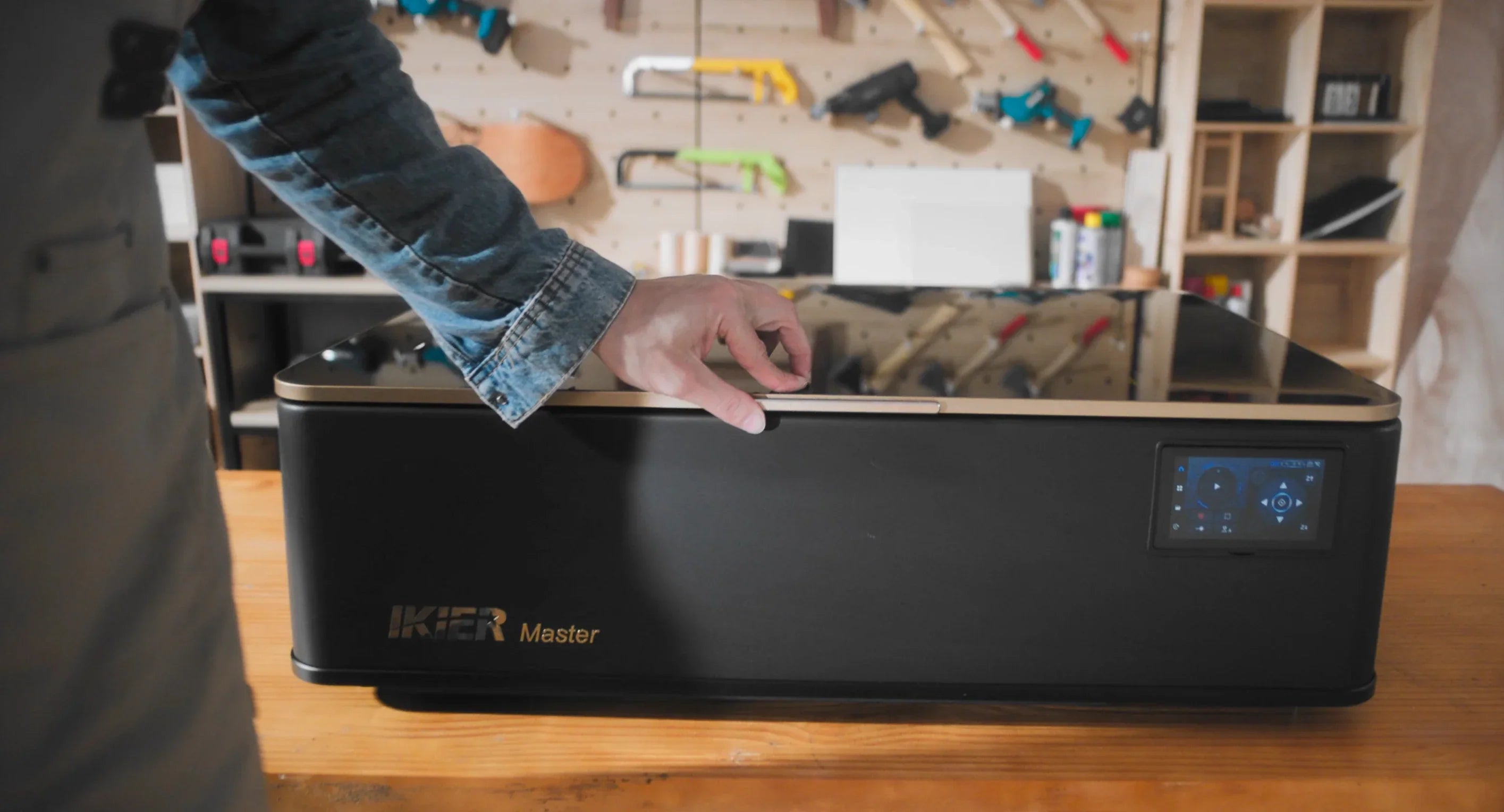
The iKier Master is a fully enclosed desktop laser machine with a 50W CO2 laser as standard and an optional 1.6W IR module, both light sources switched within the same software:
| 50W CO2 (standard) | 1.6W IR (add-on, $299) | |
|---|---|---|
| Wavelength | 10.6μm | ~1064nm |
| Role | Cutting + engraving non-metals | Surface marking on metals/engineering plastics |
| Capability ceiling | Acrylic 18mm in one pass, wood 13mm | 0.17×0.2mm spot, crisp small text |
| Work area | 500×300mm | 300×265mm |
| Typical materials | Clear/colored acrylic, wood, leather, paper; glass frosting | 304 stainless steel, anodized aluminum, gold/silver/platinum/titanium, ABS/PC |
Three capability sets built around its "order-taking tool" positioning (see the for details): a 5-inch touchscreen for PC-free offline operation with plug-and-play USB drives; a 16MP camera for batch alignment; and a Class 1 fully enclosed body (IEC 60825-1 — no safety glasses needed in normal use; protection is void with the lid open) plus flame detection, lid-open pause, and a child lock. As of July 2026, the main unit is $2,149 (MSRP $2,399) and the is $299 — check the official site for current pricing.
What Orders Can a Dual Laser Take? 5 Data-Backed Monetization Scenarios
Scenario 1: Custom Acrylic Wedding Pieces — a Big Market Only CO2 Can Enter
Weddings are the highest-ticket scenario for custom acrylic, at $200–800 per order. Clear acrylic is the entry ticket: only CO2 cuts it reliably, the 18mm ceiling covers card box panels, cut edges come out flame-polished, and the physical-probe autofocus was designed for transparent material. That Etsy card box shop's 47.4k cumulative sales prove the demand. Key point: wedding dates are hard deadlines — lock in parameters with scrap-material test cuts before running the batch.
Scenario 2: Metal Jewelry and Name Tag Engraving — the Highest Premium in Desktop Laser Work

Tiffany's $60–85 for three letters is the premium ceiling; at the jewelry store going rate of $25–65 per piece, engraving a name on a few-dollar stainless steel tag has a far better margin structure than cutting work. The IR module covers 304 stainless steel, anodized aluminum, plated metals, and gold/silver/platinum/titanium, with a 0.17×0.2mm spot keeping small text crisp. Comparable validation: an Etsy has 716.7k cumulative sales. Limits: the 1.6W marks only — evaluate fiber equipment for metal cutting; use fixtures for jewelry and test on scrap of the same material first.
Scenario 3: Frosted Glass Engraving — Surface Work Can Sustain Evergreen Products Too

CO2 can only do surface treatment on glass: it rapidly heats the surface layer, forming a white frosted finish of micro-cracks — it cannot cut glass, and you should tell clients this before taking the order. But "surface only" doesn't mean low value: one 11-year Etsy shop's (from $39.95) have 203.6k cumulative sales. Glassware has high repeat-purchase and gifting frequency — ideal as a standard product with a personalization option.
Scenario 4: Markets and On-Site Personalization — Bring the Machine to the Orders

When a customer watches their own name appear on an item within minutes, both conversion rate and average ticket beat online-and-wait. PC-Free exists for exactly this: touchscreen + USB drive means no laptop rig at markets, pop-ups, or wedding venues; store templates in AtomStack Studio beforehand and change only names and dates on site. At $10–25 per piece, one weekend of engraving service can cover the booth fee.
Scenario 5: Own-Brand Packaging and Small-Batch B2B — Two Light Sources in Rotation
Engrave your brand name on leather packaging, paper cards, and small order inserts — every package becomes a second impression. CO2 handles leather and paper (low-power fast passes, with 28 L/min air assist controlling focal-point smoke); IR handles ABS/PC plastic parts and metal tags. For gift shop and corporate small-batch jobs, the 16MP camera's batch alignment saves repeated material placement time — B2B unit prices are low; you earn on efficiency.
Material Quick Reference and the 3-Step Parameter Method
| Material | Laser | Process | Note |
|---|---|---|---|
| Clear/colored acrylic | CO2 | Cut (≤18mm), engrave | Only CO2 cuts clear stock |
| Basswood/plywood | CO2 | Cut (≤13mm), engrave | Lower thickness expectations for hardwood |
| Leather/paper | CO2 | Cut, engrave | Low power, fast speed |
| Glass/ceramic/stone | CO2 | Surface frosting only | Cannot cut |
| 304 stainless/anodized aluminum | IR | Surface marking | Plated metals same path |
| Gold/silver/platinum/titanium jewelry | IR | Fine marking | Test on scrap first |
| ABS/PC plastic | IR | High-contrast marking | Confirm chlorine-free |
| PVC/most faux leather (chlorinated) | Neither | Do not process | Releases corrosive gases when heated |
Don't copy fixed parameter tables — use a fixed three-step method in AtomStack Studio (free, four platforms, 50+ presets, LightBurn-compatible): load the material preset → run a 10×10mm test cut in a corner → fine-tune in 5%–10% steps and save a custom preset. Reuse within the same batch; retest when the batch changes — material batches, humidity, and lens condition all cause parameter drift, and a ruined production run costs far more than a test cut.
Safety Red Lines
-
Forbidden materials: PVC and most faux leather contain chlorine and release corrosive toxic gases when heated — no laser should ever process them; some colored art glass contains heavy metals, so confirm composition first
-
Fume extraction: vent outdoors or use an air purifier — this is the default, not an option
-
Hardware protection: flame detection, lid-open pause, and child lock — three layers of protection at the hardware level
If You Remember Only Three Things
-
Wavelength determines the division of labor: cutting through non-metals takes the 50W CO2, permanent marks on metal and plastic take the 1064nm IR — no light source does everything
-
The two most valuable desktop order types (custom clear acrylic + metal engraving) used to require two machines; now one main unit plus a $299 module closes the gap
-
Platform data only proves things sell; whether you profit depends on order sources, pricing, and capacity — check your own order list against the 5 scenarios before deciding to buy
FAQ
Q1: Can the 50W CO2 engrave metal?
A: No. Metal strongly reflects 10.6μm — no amount of power helps, and the reflected light can damage the optics. Metal marking belongs to the IR module.
Q2: Is 1.6W IR really enough? Can it cut metal?
A: Marking depends on wavelength match and spot precision, not absolute power: 1.6W at 1064nm is enough to leave micron-scale permanent marks on stainless steel and gold/silver/platinum/titanium. It marks only — metal cutting requires fiber equipment.
Q3: Why does clear acrylic require CO2?
A: Clear acrylic barely absorbs blue light but absorbs 10.6μm strongly. Maximum single-pass depth is 18mm (varies by batch), and the physical-probe autofocus was designed specifically for transparent material.
Q4: I already own a diode laser — is a dual laser worth the upgrade?
A: Check your order list: if the jobs you've had to turn away cluster in clear acrylic and metal engraving, the dual laser fills exactly those two gaps. If your orders are mostly wood and dark materials, the diode is enough — don't pay for capability you won't use.
Q5: Why can't PVC be laser processed?
A: PVC and most faux leather contain chlorine and release corrosive toxic gases when heated, harming both people and machines. Confirm material composition before cutting.
Data and sources: Acrylic market size from (figures vary by research firm); wedding signage order values are industry blog estimates from ; engraving fees from the and publicly listed jewelry industry rates (at time of writing); the personalization premium is from


